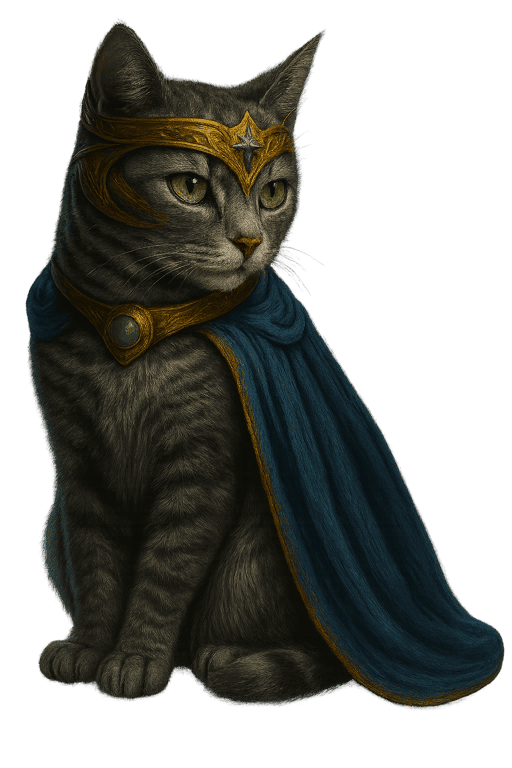
Atomm AI · the Night Shift experiment
I Tested xTool’s Atomm Against the World’s Smartest Models — The Results Surprised Me
I gave GPT Astra, GPT Sol and Atomm the same Halloween brief. Atomm’s unedited design was my clear visual favorite.
See the three designs ↓By The Crafty Catsman
October 12, 2026 · Original design test + how-to

Color shows depth, not a finished UV print.
Disclosure: xTool supplied our X1 and O1 review units. The visual verdict here is my own. A marked paid link may earn us a commission at no extra cost to you.
Put the results next to each other
The same idea.
Very different instincts.
A seated cat. A pumpkin steam train. A railway station. A moon, bat and friendly ghost. Each workflow received the same written brief for a layered design about 160 mm tall, cut from nominal 3 mm basswood.
GPT Astra
GPT-6 Astra · ultra

A cheerful, simple illustration. The pumpkin face reads immediately; the station and sky feel more like separate icons.
Code-authored SVG · four parts160 mm high
GPT Sol
GPT-6.1 Sol · ultra

A clear pumpkin-and-railway idea, but the stacked shapes compete for space. Part of the ghost disappears behind the outline.
Code-authored SVG · four parts160 mm high
Atomm
My pickLayered Laser Cutting
The locomotive, arched windows and railway signals belong to the same scene. This was the design I wanted to make.
Specialist generator · five parts160.1 mm high
Digital previews of the selected original geometry. Colors distinguish layers. All three are shown at a comparable display height; these are not photographs or print-quality comparisons.
The difference that matteredA design I wanted
to make.
For me, Atomm’s advantage was the composition. The engine looks like a pumpkin and a locomotive. The station has a roofline, arched windows and detail that reward a closer look. Even the side-on cat silhouette gives the scene room to breathe.
The GPT versions communicate the brief, but Atomm’s result feels more like a craft design I would choose for the shelf. That is a visual judgment about these outputs, not a claim that Atomm beats every general-purpose model at every task.
How I kept the comparison honest +
I used GPT-6 Astra and GPT-6.1 Sol with ultra reasoning, independently, through a text-and-code workflow. They wrote SVG geometry. Atomm used its specialist Layered Laser Cutting generator with Cat, Wood tone and Basswood selections. The written brief was unchanged; Atomm trimmed its final newline.
The comparison preserves the first GPT candidates and the selected four-layer Atomm export without design repairs. Atomm’s session included a stalled attempt and a layer-count mismatch before that controlled export. So “unedited output” is the accurate description—not one successful Generate click with no setup retries. Equal prompts did not mean equal tools, compute or attempt histories.
Astra and Atomm were subsequently laser cut. I reported that the Atomm cut worked well. Sol was prepared for cutting, but a completed cut is not documented. This page’s winner is the visual design; assembled durability and UV finish are separate questions.
The brief does a lot of the work
Ask for an object.
Describe how it has to work.
“Make a Halloween cat” leaves almost everything open. I specified size, material, depth order and connections, then asked for editable files. You can use the same approach for your own subject.
The exact comparison prompt
Copy it. Then make it yours.
Read the full Night Shift prompt +
Design a Halloween cat-silhouette layered shadowbox called NIGHT SHIFT for laser-cut nominal 3 mm basswood. Make a charming scene, finished height 160 mm and width no more than 130 mm. Use the same seated-cat outer silhouette and aligned coordinate origin on every component. Do not mirror parts. No text, logos or lettering in the artwork.

Deliver THREE DISTINCT OPEN SCENE PLANES, front to back: (1) a recognizable pumpkin-shaped steam locomotive on a connected rail/ground band; (2) an old railway station with a readable roof, windows and platform, behind the train; (3) an open night sky with a crescent moon, one bat and a small friendly ghost. The station must not share the sky plane. The sky plane must have real see-through openings, not be a solid cat silhouette with the sky merely engraved. Add a fourth separate solid cat-shaped backing. If a perimeter/front frame is needed, identify it separately and do not count it as one of the three scene planes.

Every retained decorative element must connect to its own plane's perimeter or ground through physically cuttable bridges. Avoid loose islands. Aim for minimum 3 mm bridges and webs at the final 160 mm height. Preserve recognizable negative space. Engraving may add facial features, pumpkin ribs, station trim and stars, but it must not substitute for the three separated cut-through scene compositions.

Provide actual editable SVG cut geometry with closed contours, consistent millimetre units and one aligned canvas per component. Separate cut contours from engraving artwork; any raster engraving must be identified as raster. Do not present a PNG embedded in SVG as vector geometry. Preserve source files and give each component a clear name indicating its depth order and purpose. Provide assembled and separated-parts digital previews if supported. Do not invent a measured kerf, claim strength or fit testing, or claim the design has already been fabricated. First digital candidate for review before fabrication.
For your own project, change the subject and dimensions before generating.
The 3 mm bridges in the brief are a design target, not proof the output met it. All three candidates had details worth checking. A detailed prompt helps; it does not replace inspection.
Try the workflow
From a written idea
to separate, useful parts.
- 01
Choose the right generator.
Open Atomm and find Layered Laser Cutting in its AI tools. For this flat cat, I used the layered generator—not the separate Structure Build route for boxes and assembled objects.
- 02
Paste the brief. Check the controls.
Use the prompt above, select Cat, Wood tone and Basswood where available, and set four tool layers: train, station, open sky and backing. Check the visible layer count and credit quote before you generate; interface labels and charges can change.
- 03
Keep the output before improving it.
Download the original package. Save the prompt and a preview alongside it. In this result, Atomm supplied a separate top frame, so the four requested layers became five physical parts.
- 04
Inspect the actual files.
Check that the sky has real openings, the station is a separate plane, and small details connect to retained material. View the aligned stack to catch hidden features. An SVG can contain both vector cut paths and raster print art; the file extension alone proves neither.
- 05
Prepare for your material.
Open the cut geometry in your machine software, confirm its dimensions and assign cut and engraving operations deliberately. The cat’s outline is about 160 mm tall even though its SVG canvas is larger. Our five parts fit one 12 × 12-inch sheet with rigid placement only.
- 06
Test, make, then share what you learned.
Use your machine’s verified settings for the actual material, inspect small features, and dry-fit the layers. Record changes and photograph the real result. If you add UV color, keep the print art registered to the cut parts and test alignment before a full print.
The picture is only the beginning.Switch views to see the parts behind the layered composition.
Open the full sheet preview ↗New to the handoff? Our LightBurn guide covers another common laser-software route. For color on cut pieces, start with UV printing basics and material and adhesion tests. No universal cut or print settings are implied by this design.
Before you press Generate
Credits are your tool budget.
Think of credits as units you spend on Atomm tools. The quote depends on the tool and operation, so check it before each run. A free allowance, earned credits, purchased credits and creator Coins are different things.
Free uses
Atomm’s published credit-system guide describes limited monthly free uses. Check your account’s current tool counter; it is not unlimited generation.
Credits
Qualifying community activities can earn reward credits. Purchased credits provide another way to use the tools. Read the expiry and spending terms for each balance.
Coins
Coins belong to the creator-reward system. They are not the same unit as AI-tool credits, and earning them depends on program eligibility and terms.
How the balance works
Atomm spends available free uses first, then Reward Credits, then Purchased Credits. Purchased Credits do not expire. Reward Credits do; use the expiry date for each batch in your Credits Center, because Atomm’s public pages give conflicting durations. Credits cannot be cashed out. Credit rules ↗
Checked October 12, 2026: the US store lists 1,000 credits for $10 and 2,000 for $20—one cent per purchased credit. These are credit packs, not a per-project price. Check the current credit packs ↗(paid link)
What this session actually used
60reward creditsNo new cash purchase.
What Atomm actually charged.
Our balance went from 63 to 3 across the session. The controlled four-layer take displayed 6 credits per layer—24 in quoted arithmetic—but the refreshed balance fell by 36 during that take. The records do not explain the difference.
I would not tell you this cat “cost 24 credits.” Check the quote, retain the export, and compare your balance afterward. For the GPT entries, we used existing subscription access; a trustworthy per-design dollar cost was not available.
Make something. Give something back.
Your next idea can start
with somebody else’s experience.
Atomm’s community is part of the appeal. A useful project can give another maker a starting point, and eligible contributions can earn credits to keep experimenting.
Share a usable project.
Include the files you have the right to share, material, settings, assembly notes and photographs of the actual result. Explain any AI assistance and corrections. A pretty render alone is not a completed-project record.
Make your feedback useful.
Ask specific questions, leave genuine comments, share qualifying projects and discuss what worked. An idea or collaboration helps the community, but it earns credits only when it meets a listed reward task.
Choose how you share.
Read the current reward rules before publishing. Exclusive and non-exclusive contributions have different terms; exclusivity affects where you can distribute the design. Do not choose it simply to chase a larger reward.
Practical ways to earn more credits
Examples from the public rules, checked October 12, 2026. Complete the qualifying task shown in your Credits Center; publishing rewards require approval.
| Contribution | Reward Credits | Limit |
|---|---|---|
| Genuine comment | 10 | Once per day |
| Qualifying social share | 10 | Once per day |
| Another approved project | 50 | Once per day |
| Publish material settings | 50 | Once per day |
| Publish a generator | 200 | Once per day |
Published non-exclusive projects can also earn 6.7–15 credits per valid use, depending on quality. Atomm counts a download or export as one valid use and a real Studio-reported job as two; repeat and invalid activity are excluded. Current reward table ↗
Exclusive projects can earn Coins instead. Exclusivity applies to that project’s files and is a long-term commitment: the current guide says it cannot be voluntarily reversed. Finished-object photos and tutorials can still be shared elsewhere. Read the agreement before choosing that option. Creator terms ↗
Current Creator Program offers ↗Atomm project content standards ↗The best contribution is the detail you wish you had known: which layer goes first, which small feature needed care, or how you registered the print. Our maker stories show how much useful knowledge lives in those particulars.
Why I’m paying attention
A better starting point
changes what you’re
willing to make.
Atomm gave me a design I wanted to take to the laser. That is why xTool’s investment in AI matters to me: it made this project easier to start.
Design tools
More help with the artwork
Atomm 4.1 added color in 3Dmake, Pinterest integration, and improvements to layering and vector tools. These are useful steps toward turning an idea into workable files.
See what changed in Atomm 4.1 ↗Creator rewards
A reason to share what works
xTool announced a $1 million Creator Program. Usable files, settings and build notes can help the next person make something—and qualifying contributions can earn rewards.
Read the Creator Program rules ↗In the workshop
A design I wanted to make
Atomm was my visual favorite, and its exported parts went on to the laser. The files still needed inspection; a good-looking preview is only the beginning.
See our X1 workshop projects →For this project, xTool’s work on AI paid off in the design experience. That is my result from one brief, not a measure of financial return or a promise that every output is ready to cut. The $1 million announcement funds creator rewards; it is not a disclosed AI research budget. xTool’s announcement ↗
Your turn
Start with one idea
you actually want to make.
Give it a size, a material and a purpose. Keep the original output. Check the file. Then let the result earn its place on your workbench.
UV color is a possible next chapter for these cats. This comparison stands on the original designs; the previews above are not finished prints.
Sources & further reading
Workshop comparison: October 8, 2026. Article and public rules checked October 12, 2026. Tool interfaces and rewards may change.
- Current US Atomm credit packs ↗(paid link)
- Atomm credit balances, rewards and expiry ↗
- Atomm credit system and free uses ↗
- Atomm Creator Program rules ↗
- Current Creator Program offers ↗
- Atomm project content standards ↗
- Atomm 4.1: tools and creator rewards ↗
- xTool’s September AI creation suite announcement ↗