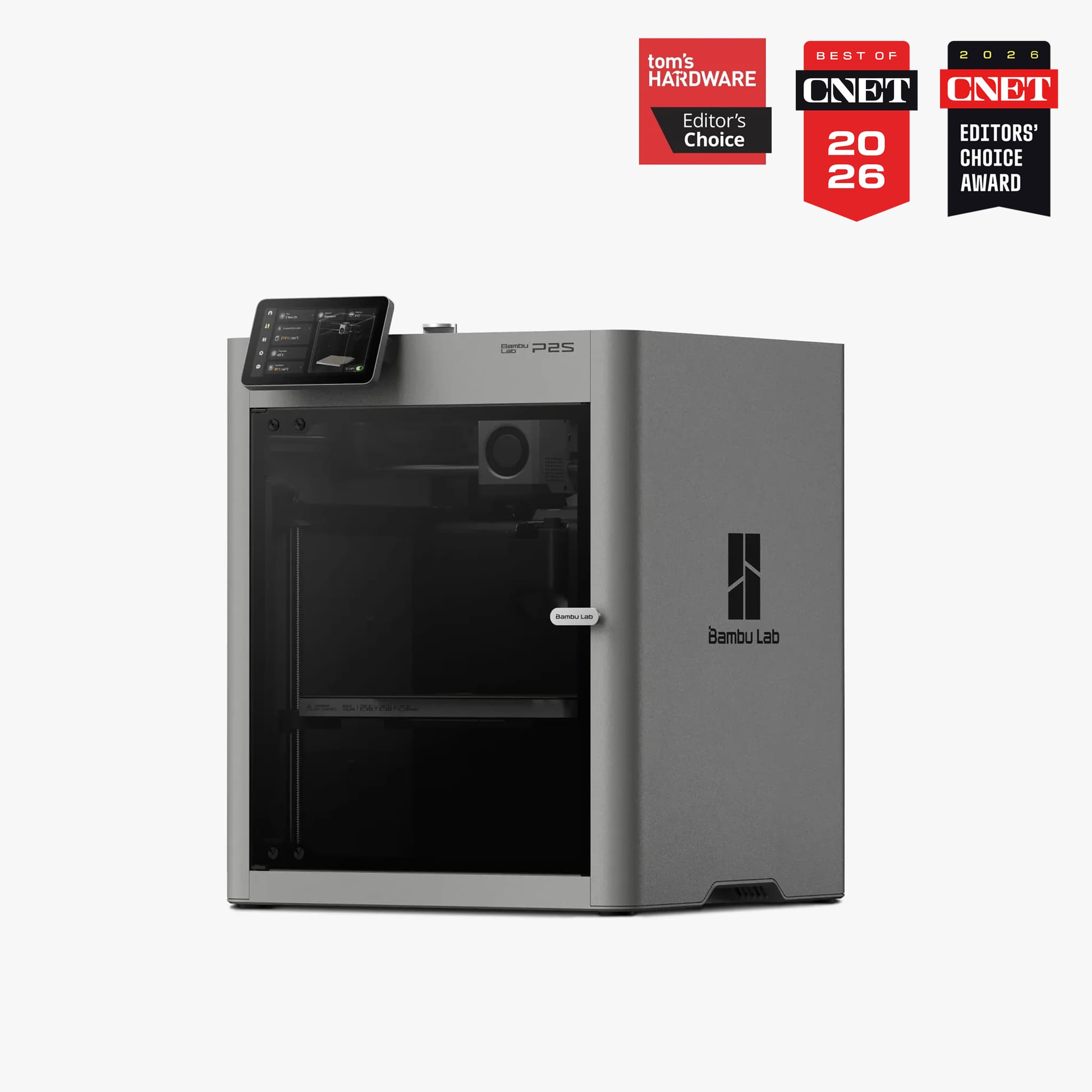
| Launch date | October 14, 2025. Bambu introduced it as a reengineered P-series machine borrowing newer H-series technology. | July 2023. Bambu introduced it as the enclosed P-series successor to the open-frame P1P. |
| Price signal in the U.S. | The launch announcement listed EUR519 for P2S and EUR749 for P2S Combo in Europe. U.S. offer signals around May 2026 put the base printer near $549 and the AMS 2 Pro Combo near $799, but checkout is the source of truth. | The P1S originally sat higher, but U.S. sale pricing often makes it a $449-$549 decision. Add the AMS cost when comparing combo-to-combo value. |
| Build volume | 256 x 256 x 256 mm enclosed build volume. | 256 x 256 x 256 mm enclosed build volume. |
| Extruder and drive | PMSM servo extruder with up to 8.5 kg extrusion force and 20 kHz resistance/position sampling for grinding and clog detection. | Direct-drive P-series extruder with all-metal hotend and 0.4 mm stainless-steel nozzle in the standard official configuration. |
| Flow calibration | Auto Flow Dynamics Calibration uses an eddy-current sensing approach and software compensation to adjust flow behavior. | Strong default profiles, but no P2S-style automatic flow dynamics calibration. Advanced tuning is more manual. |
| Cooling and chamber behavior | Adaptive Airflow can pull cool external air for lower-temperature filaments or preserve heat through internal circulation behavior. | Fully enclosed body with fan/filter stack, but no servo-controlled Adaptive Airflow system. |
| Active chamber heating | No. Bambu FAQ says the P2S regulates chamber temperature through enclosure and circulation switching, not an active heater. | No. Treat it as a fast enclosed CoreXY printer, not an actively heated chamber printer. |
| User interface | 5-inch second-generation touchscreen with richer graphics, guidance, and direct printer control. | Small monochrome LCD with D-pad controls. Most day-to-day control usually happens through Bambu Studio or Bambu Handy. |
| Sensors and monitoring | AI error detection for spaghetti, nozzle blobs, and air printing, plus build-plate/nozzle cross-checks and 1080p high-rate live view. | Automatic bed leveling, vibration compensation, filament-run-out sensing, and built-in camera, but not the same AI monitoring package. |
| Nozzle and hotend service | Quick-swap nozzle/hotend assembly with one-clip release and no wiring connections. Bambu lists 0.2, 0.4, 0.6, and 0.8 mm support. | More traditional P-series hotend service path with screws and wiring, so nozzle changes take more care. |
| AMS path | P2S Combo ships with AMS 2 Pro. Bambu FAQ says P2S can connect up to 4 AMS 2 Pro units and 4 AMS HT units for 20 slots. | AMS compatible and now also compatible with AMS 2 Pro, but the older P1S value story depends heavily on the bundle price you find. |
| Bed and material temperatures | PEI-coated flex plate, 300 C max nozzle, and 110 C max heatbed in Bambu launch specs. | Textured PEI plate, 300 C max nozzle, and 100 C class heatbed in the standard P1S lane. |
| Speed and motion | Same fast CoreXY family. The practical edge is not bed size; it is keeping flow more controlled as prints get faster or more demanding. | Official P1S material calls out 500 mm/s max toolhead speed and 20 m/s2 acceleration. |
| Best fit | New buyers, print farms, small shops, and daily users who will benefit from fewer interruptions and easier maintenance. | Budget-sensitive buyers who want a proven enclosed Bambu machine and do not need the newer P2S refinements. |