
Material changes can become tool changes
A dedicated hotend can stay assigned to a filament instead of forcing every color or material through one melt path. That is the core Vortek advantage—not simply “more colors.”
Official-source buyer guide · Checked August 21, 2026
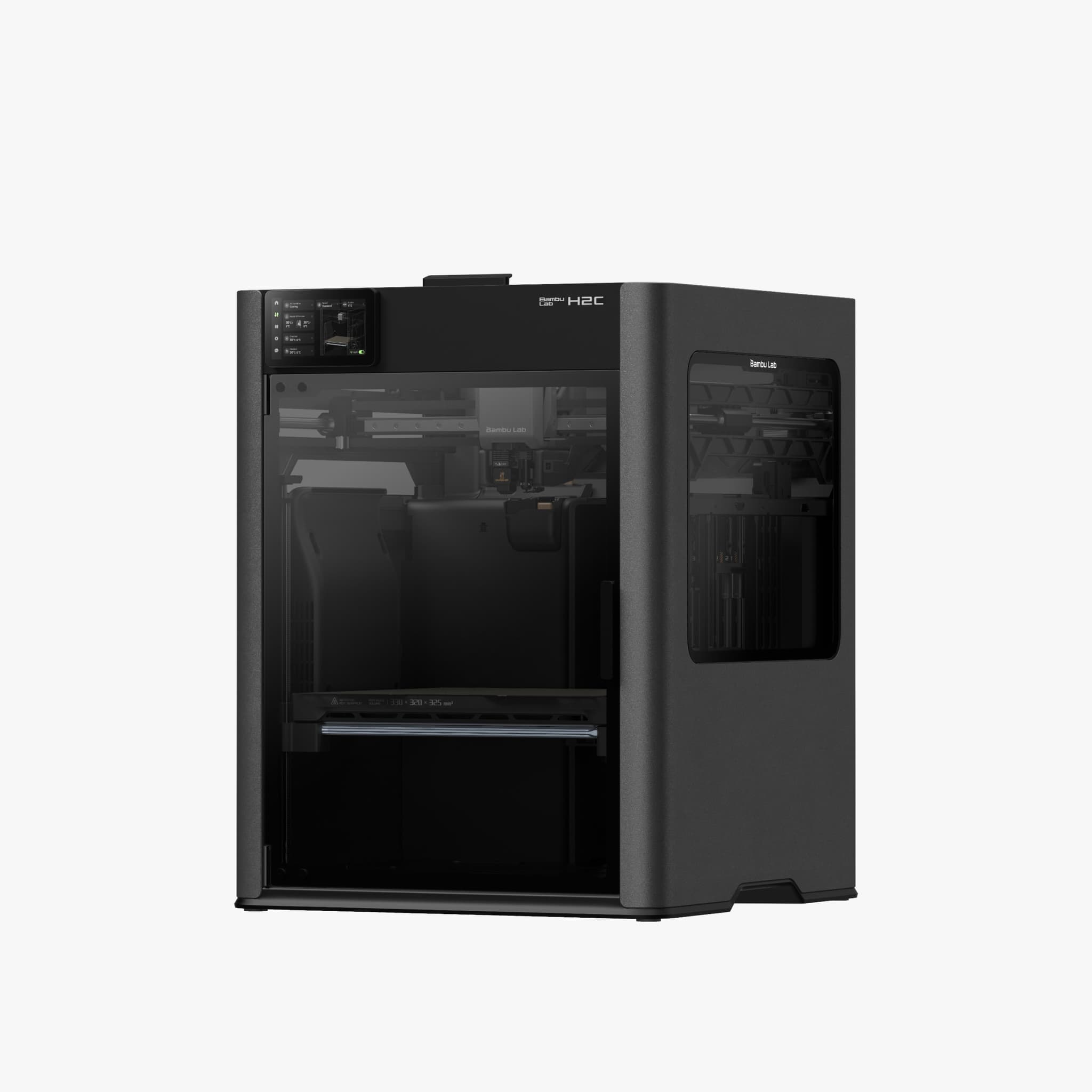
The H2C is not the simple dual-extruder printer this page once described. Its defining system is a fixed left nozzle plus six swappable Vortek hotends, built to keep several colors or materials on dedicated melt paths.
Evidence boundary: stable specifications and today's store display come from Bambu Lab. We have not independently tested swap reliability, purge savings, print quality, maintenance, service, or long-run production behavior.
The decision in front of you
The H2C earns its premium by changing how filament and hotends are assigned. If that does not solve a recurring job, the added hardware is mostly unused complexity.
A dedicated hotend can stay assigned to a filament instead of forcing every color or material through one melt path. That is the core Vortek advantage—not simply “more colors.”
Long-run alignment, failed swaps, hotend contamination, maintenance time, firmware recovery, service, and real purge savings need independent use—not a spec-sheet conclusion.
If you mainly print fixtures, brackets, organizers, and prototypes from one loaded material, the owned P2S remains the simpler and far less expensive workshop path.
The H2C combines a conventional left nozzle with a right-side Vortek system that can pick up six small induction-heated hotends. Bambu positions those seven tool paths as a way to keep colors or materials separate instead of unloading, purging, and reloading one nozzle for every change.
That is materially different from a two-nozzle description. It can matter for detailed color work, support interfaces, flexible-plus-rigid assemblies, or jobs where residue from one material should not pass through the next material's hotend. It also adds a rack, more hotends, more calibration states, and more failure modes that owner testing still needs to characterize.
The live U.S. store currently exposes four exact H2C variants: the AMS Combo, separate 10W and 40W Laser Full Combos, and the Vortek Ultimate Bundle. These values are a dated snapshot, not a permanent price promise and not an offer from The Crafty Catsman.
| Configuration | Displayed price | Compare-at price |
|---|---|---|
| H2C AMS Combo | $2,199 | |
| H2C Laser Full Combo - 10W Laser | $2,599 | |
| H2C Laser Full Combo - 40W Laser | $3,149 | |
| H2C Vortek Ultimate Bundle | $2,399 |
Availability signal: Each exact H2C variant's official JSON-LD Offer reported https://schema.org/InStock on 2026-08-21. Verify the selected bundle, included equipment, taxes, shipping, return terms, and live cart before buying.
The useful H2C question is not “is it Bambu's best printer?” It is “does my work repeatedly pay back dedicated material paths, active chamber heat, or the larger H-series envelope?”
| Job | H2C fit | Why |
|---|---|---|
| Complex multicolor display work | Strong on paper | Seven dedicated tool paths can reduce the purge-heavy color-change loop, subject to model layout and actual workflow results. |
| Rigid part plus flexible or support interface | Potentially strong | Separate hotends reduce cross-contamination risk, but exact material pairing and adhesion still require job-specific validation. |
| Engineering filament prototypes | Promising specification set | 350 C nozzles and a 65 C active chamber expand the official material lane; independent repeatability remains to be proven. |
| Everyday PLA/PETG fixtures | Usually excessive | The Vortek price and complexity are hard to justify when the work does not use dedicated tools or chamber heat. |
| Production-critical unattended work | Wait for evidence | A manufacturer feature list is not a service record, failure-rate study, or proof of recoverability after a bad swap. |
Need clear acrylic or thicker cuts than the H2 laser modules handle? Compare the Bambu Lab R1 CO2 laser.
A sophisticated tool-changing printer should be judged on the ugly moments as much as the showcase prints: a pickup that does not seat, a nozzle offset that drifts, a filament that strings across the rack, a firmware recovery after interruption, and the time required to clean several material paths.
We do not yet have that evidence. Until owner hours and independent tests accumulate, treat Bambu's purge, accuracy, AI-detection, speed, and reliability language as a test agenda. We will not convert it into an editorial verdict simply because the feature exists on the product page.
Repeated pickups, seating, offsets, contamination, recovery, and wear across all hotend positions.
Same model, same filament, and comparable quality against single-nozzle AMS and simpler dual-nozzle workflows.
Cleaning labor, replacement-part availability, downtime, firmware behavior, and support response under real use.
Our P2S recommendation comes from owning and using it. The H2C guidance does not. That difference matters more than a longer spec table.
Choose the P2S when you want an enclosed CoreXY workshop printer for repeatable fixtures, brackets, organizers, prototypes, and mostly one-material-at-a-time work. Move to the H2C when a recurring job genuinely needs dedicated tool paths, more material separation, a larger envelope, or a 65 C active chamber—and when you can justify a roughly $2,200-class AMS Combo before accessories.
Use the evidence that matches the decision
If the H2C still fits after the caveats, verify today's configuration directly with Bambu. If the work sounds simpler, start with the machine we actually live with.
Primary sources
Both sources are first-party Bambu Lab pages. They establish specifications, configurations, and manufacturer claims; they do not replace independent testing.
Live store offers checked August 21, 2026. The historical announcement was last verified July 21, 2026; its publication date remains November 14, 2025.
Current official facts, with the evidence boundary kept visible.
No. This is a source-backed buyer guide built from Bambu Lab’s official U.S. product page and H2C announcement. The live store offers were checked August 21, 2026. The Crafty Catsman has not tested the H2C, so durability, service, real purge savings, and production reliability remain open questions.
Bambu Lab says the H2C can use its fixed left nozzle plus six Vortek hotends for up to seven colors or materials without nozzle purging. The company also advertises expansion to as many as 24 filaments with additional AMS hardware. Those are manufacturer capability claims, not independent bench results from this site.
The official U.S. store displayed the H2C AMS Combo at $2,199 against $2,399, the 10W Laser Full Combo at $2,599 against $2,949, the 40W Laser Full Combo at $3,149 against $3,599, and the Vortek Ultimate Bundle at $2,399 against a $2,674 separately-purchased total. Prices, included equipment, and availability can change, so verify the selected configuration in the live cart.
Yes. Bambu Lab’s official specification lists a 65 C active heated chamber and a 350 C maximum nozzle temperature. Those specifications expand the high-temperature-material path, but they do not by themselves prove print quality or warp-free results for every geometry and filament.
Buy up to the H2C when dedicated tool paths, reduced purge between several colors or materials, a larger envelope, or active chamber heat are central to your work. If you mainly print one material at a time, the owned P2S is the simpler and much less expensive workshop choice.
Bambu Lab’s U.S. “What’s in the box” table lists eight hotends: four 0.4 mm induction hotends, one 0.2 mm induction hotend, one 0.6 mm induction hotend, and two 0.4 mm hardened-steel hotends, plus the printer, build plate, spool holder, and other setup items shown on the official page.
Continue the 3D-printing decision